

Every home has a perimeter, and it is far larger than the property line. It begins at the ridge, where shingles and flashing turn away rain and wind. It runs along the eaves, where runoff is collected and carried off. It extends down the walls and across the foundation, where gaps and cracks invite insects and rodents, and it continues underground, where supply lines, waste lines, and buried treatment systems move water to and from the house. Even the yard belongs to this boundary, shaping how storms drain, how roots spread, and how close hazards can come to the structure itself.
Keeping that perimeter secure and its lines running clear is what keeps a home sound. Most damage begins with something small slipping through a weak point: a lifted shingle, a clogged channel, an open gap beneath siding, a slow drain, or a loose electrical connection. Each one seems minor until it spreads into framing, finishes, or soil. Owners who treat the perimeter as a single connected defense, inspecting it on a schedule and correcting weak points promptly, protect the structure, the people inside it, and the long-term value of the property.
Replacing Wind-Torn Shingles and Resealing Skylight Curbs
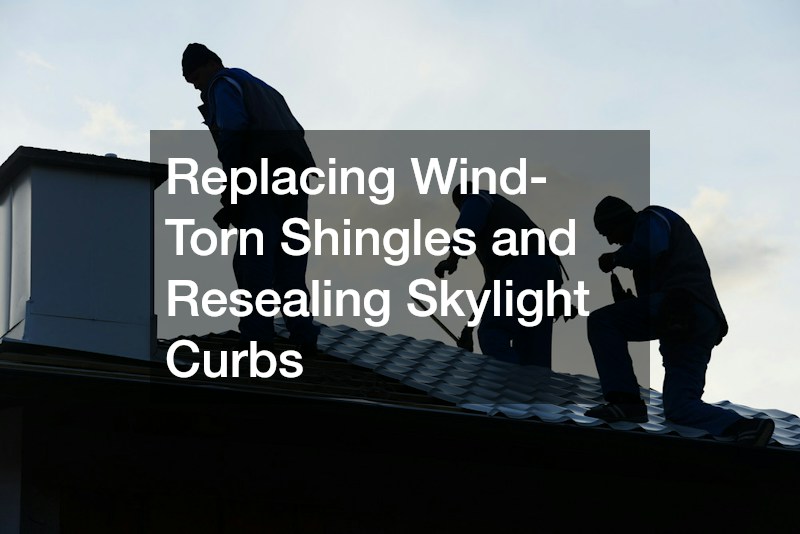
Strong gusts work on asphalt shingles in a predictable way. Wind gets under the leading edge of a tab, flexes it upward, and breaks the factory sealant strip that holds it down. Once released, the tab flaps with every storm until it creases, tears, or blows off entirely, exposing nail heads and underlayment to rain. Skylights present a separate weak point. The curb they sit on interrupts the shingle field, and when step flashing corrodes or sealant shrinks along the frame, water runs behind the curb and into the ceiling below.
A skilled local roofer starts by walking the surface to document torn, creased, and missing tabs, then carefully breaks the seal on surrounding shingles so replacements can slide into place without damaging good material. New shingles are fastened with ring-shank nails at the manufacturer’s nailing line and hand-sealed with asphalt cement in high-wind zones. At skylights, crews remove old flashing, wrap the curb in self-adhered membrane, and install new step and head flashing woven with the shingles, sometimes replacing the entire flashing kit to keep the opening watertight for years.
Screening Open Troughs and Blocking Seasonal Leaf Buildup
Open channels along the eaves collect more than rainwater. Leaves, pine needles, seed pods, shingle granules, and twigs pile up through every season, forming wet mats that block outlets and hold standing water. The added weight pulls hangers loose, overflow pours down siding and soaks the soil along the foundation, and trapped moisture rots fascia boards. Clogged channels also attract mosquitoes and give birds and rodents a sheltered place to nest close to the roofline.
Professional gutter guard installation begins with a thorough cleaning and inspection of the existing system, including hangers, seams, and fascia. Damaged sections are repaired and pitch is corrected so water flows toward outlets. Installers then fit stainless steel micro-mesh panels or solid-surface covers secured beneath the first shingle course or to the front lip of the channel. The fine mesh blocks needles and grit while letting heavy rain pass through, keeping the system flowing freely with only occasional rinsing.
Removing Rotting Trunks and Lowering Limbs Over Structures
Decay often advances quietly inside a mature specimen. Fungi enter through old pruning wounds, storm breaks, or damaged roots and begin breaking down the heartwood, hollowing the trunk while the canopy may still look full. Mushrooms at the base, cavities, oozing cracks, and dead branches high in the crown signal that strength is slipping away. When a weakened trunk stands within striking distance of the house, garage, or power lines, a single storm can send tons of wood crashing onto the structure.
Safe tree removal begins with an arborist’s evaluation that measures the extent of decay, sometimes using a resistance drill or sonic tomography to map hollow sections. Climbers then rig limbs hanging over the house and lower them with ropes and friction devices, while cranes lift heavy sections over roofs in tight spaces. The trunk is taken down in controlled pieces, the stump is ground below grade, and debris is chipped and hauled away. Any remaining specimens nearby are inspected for shared root decay before the crew leaves.
Sealing Rodent Entry Gaps and Treating Nesting Areas
Mice can squeeze through openings about the width of a pencil, and rats need only a gap roughly the size of a quarter. Common entry points include gaps around plumbing and utility penetrations, unscreened vents, damaged soffits, garage door seals, and openings where siding meets the foundation. Once inside, rodents nest in attics, wall cavities, and crawlspaces, shredding insulation, chewing wiring, and leaving droppings and urine that contaminate surfaces and spread disease.
Licensed exterminators start with a full inspection of the exterior and interior, identifying entry points, runways, and nesting areas by tracking droppings, rub marks, and gnaw damage. Gaps are sealed with steel mesh, copper wool, metal flashing, and durable sealants, and vents receive heavy-gauge hardware cloth. Inside, technicians use traps and secured bait stations to eliminate active populations, then remove contaminated insulation and sanitize nesting areas with enzyme-based cleaners. Follow-up visits confirm that activity has stopped and that no new gaps have opened.
Replacing Leaky Toilet Flanges and Rebuilding Rotted Subfloors
A toilet that rocks, a floor that feels soft, or a stain on the ceiling below usually points to a failed seal at the flange. Over time, wax rings compress and lose their seal, flanges crack or corrode, and loose mounting bolts let the fixture shift with each use. Every flush then pushes a little water into the subfloor, where it soaks into plywood or OSB, rots joists, and feeds mold. Because the damage stays hidden beneath the fixture, it can spread across a large area before anyone notices.
Experienced bathroom contractors pull the toilet and remove flooring around the flange to measure the extent of the rot, cutting out damaged subfloor back to sound material and sistering or replacing weakened joists. New plywood is glued and screwed to the framing, and a stainless steel or PVC flange is anchored at the correct height relative to the finished floor. A new wax ring or wax less seal and corrosion-resistant bolts secure the fixture, and new tile or vinyl completes the repair.
Snaking Stubborn Clogs and Scouring Grease-Coated Pipes
Waste lines narrow gradually as grease, soap scum, hair, food particles, and mineral scale accumulate along their walls. Kitchen lines are especially vulnerable because fats and oils cool and harden inside the pipe, catching debris until flow slows to a crawl. Main lines can also be invaded by roots or hold sags where solids settle. Symptoms include slow sinks and tubs, gurgling toilets, foul odors, and backups at floor openings in the lowest level of the house.
Thorough drain cleaning starts with a cable machine fitted with a cutting head that bores through the obstruction and restores flow. When grease or roots line the pipe, technicians follow up with hydro-jetting, sending high-pressure water through a rotating nozzle that scours the full circumference of the pipe. A camera inspection then confirms the line is clean and checks for cracks, offsets, or bellies that could cause future clogs. Enzyme treatments and keeping grease out of sinks help keep lines flowing.
Monitoring Scum Layers and Restoring Outlet Baffles
Buried wastewater tanks rely on layers to work properly. Solids sink to the bottom, grease and soap rise to form a floating scum layer, and clarified effluent flows out to the drainfield. The outlet baffle keeps scum from escaping with that effluent, but concrete baffles corrode over time from hydrogen sulfide gas. When the baffle fails or the scum layer grows too thick, grease and solids pass into the field, clogging the soil and causing slow drains, odors, and soggy patches in the yard.
A reliable septic pumping company measures scum and sludge depths at each service to determine whether the tank needs pumping and how quickly it is filling. The tank is pumped through the main access lid, and technicians inspect the inlet and outlet baffles. Corroded or missing baffles are replaced with PVC sanitary tees, often paired with an effluent filter that traps fine solids before they reach the drain field. Recording layer measurements at each visit helps set the right pumping schedule for the household.
Upgrading Overloaded Panels and Grounding Outdated Wiring
Many older homes still rely on 60- or 100-amp service panels that were never designed for today’s appliances, electronics, and vehicle chargers. Overloaded circuits trip breakers repeatedly, overheat conductors, and stress aging components. Homes built before the 1960s may also have two-prong ungrounded outlets, which provide no safe path for fault current and leave sensitive equipment exposed to surges and people exposed to shock.
Licensed local electricians begin with a load calculation to determine whether the service needs an upgrade, often to 200 amps with a new panel and meter base. Circuits are rebalanced, and new dedicated lines are added for high-demand appliances. Ungrounded wiring is upgraded by running new grounded circuits or installing GFCI protection where code allows. Grounding electrodes and bonding connections at the panel, water service, and gas line are verified, and AFCI and surge protection complete the upgrade. A permit and final inspection confirm the new service meets current code and is safe for decades of added demand.
Setting Plumb Posts and Hanging Weather-Resistant Panels
A perimeter enclosure is only as strong as its posts. Posts set too shallow, packed in loose soil, or buried in concrete that traps water at the base lean, loosen, and rot over time. Wind loads on solid panels magnify every weakness, and frost can heave poorly set posts out of alignment. Panels made from untreated wood or low-quality materials warp, crack, and fade, while gates sag and drag across the ground.
A quality fence install starts with locating utilities and marking the layout with string lines, then digging post holes at least one-third the post length or below the frost line. Posts are set in gravel and concrete, crowned to shed water, and checked for plumb as the concrete cures. Weather-resistant panels made from cedar, vinyl, composite, or powder-coated aluminum are then attached with stainless steel or hot-dip galvanized fasteners, and gates are hung with heavy-duty hinges and anti-sag hardware. A penetrating stain or factory finish on wood components shields the boards from UV damage and moisture between periodic recoats.
Shaping Planting Beds and Directing Runoff Away From Foundations

Landscaping can either protect a home or quietly undermine it. Beds built up against siding trap moisture and give insects a hidden path into wall cavities, while mulch and soil that slope toward the house send rainwater straight to the foundation. Thirsty shrubs planted too close to the walls pull moisture from the soil unevenly, contributing to settlement, and downspouts that empty into flat beds create soggy areas that erode soil and saturate crawlspaces.
A knowledgeable landscaper regrades beds so the soil slopes away from the foundation at about six inches over the first ten feet, keeping mulch several inches below siding and weep screeds. Shrubs are relocated or spaced at least a few feet from the walls, and downspouts are connected to buried pipes, dry creek beds, or rain gardens that carry water safely away. Edging, landscape fabric, and properly chosen plants complete beds that look good while keeping water and pests at a safe distance.
A home stays sound when its boundaries remain secure and its lines stay clear. Shingles and flashing turn away weather, screened channels carry runoff off the eaves, sealed gaps keep pests outside, graded beds direct water away from the foundation, and clean waste lines and well-maintained tanks move wastewater safely off the property. Electrical systems sized and grounded properly keep power flowing safely through it all. When one part of the perimeter weakens, pressure shifts to the next, and small problems quickly multiply.
Keeping the perimeter strong takes a steady routine rather than occasional emergency repairs. Inspections after major storms, seasonal checks of drainage channels and planting beds, regular wastewater pumping, periodic waste line maintenance, electrical evaluations, and pest monitoring catch weak points early. Upgrades such as screened eaves, modern panels, and weather-resistant enclosures reduce future maintenance while improving safety and efficiency.
The result is a home that stays dry, safe, and comfortable year after year. The structure resists storms, the systems inside run smoothly, and the property holds its value. By securing the perimeter and keeping every line clear, homeowners build lasting protection around the place they depend on most.